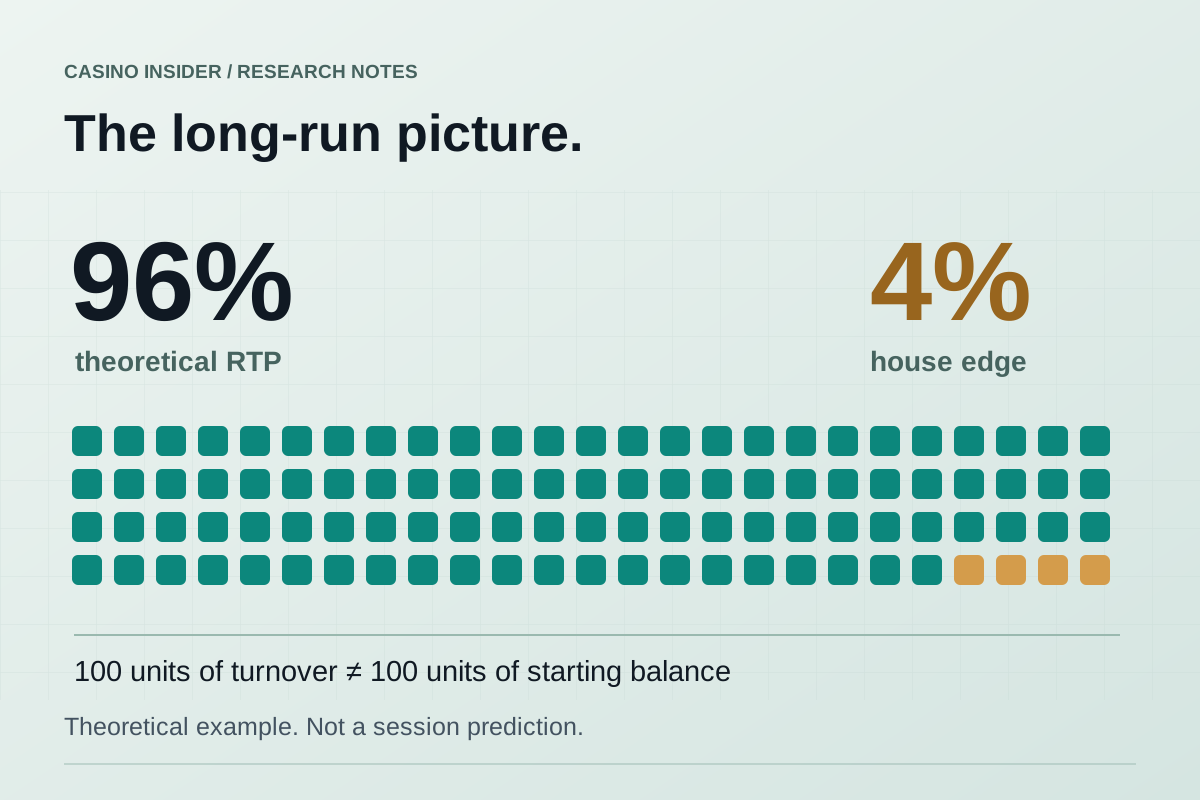
Return to player describes a game’s long-run theoretical return under its stated rules. It is not a promised return for one player or session. In a simple fixed-return example, house edge is 100% minus RTP. Volatility describes the spread of outcomes; two games with the same RTP can feel very different.
Published by a BC.GAME commercial partner. This guide is desk research, not a funded account test. Methods & disclosures.
In this guide
Separate the four numbers
The Gambling Commission explains RTP as an average over substantial play, not a promise attached to an individual stake. Its monitoring guidance distinguishes actual RTP from theoretical RTP and discusses sample size and volatility.
| Term | What it describes |
|---|---|
| Theoretical RTP | The modelled long-run proportion returned under the game’s rules. |
| Actual RTP | Recorded prizes divided by recorded stakes for a particular sample. |
| House edge | Expected operator advantage under the stated assumptions. |
| Volatility | How widely results can vary; it is not a personal win probability. |
A £1,000 turnover example
Assume a fixed theoretical RTP of 96% and £1,000 in total stakes. The theoretical returned amount is £1,000 × 0.96 = £960. The corresponding theoretical loss is £40. These are expected values, not a forecast of the next session.
Total stakes means turnover, not the amount initially deposited. If a balance is wagered repeatedly, the cumulative stakes can exceed the deposit. A calculation based only on a deposit will answer a different question.
Why the same RTP can produce different experiences
A game can distribute its expected return across frequent smaller prizes or less frequent larger prizes. RTP alone does not specify that distribution. It cannot tell you the chance that your particular balance lasts for a given number of rounds.
A small observed sample can diverge sharply from the theoretical value. An unusually good or bad session does not, by itself, establish that the published RTP is false. Equally, a published number does not replace checking the exact game version and its rules.
Actual RTP is a description of a sample
Suppose a clearly defined sample records £8,500 returned from £10,000 staked. Actual RTP for that sample is 85%. Without the sample’s game mix, size, rules and variance, that figure cannot establish a universal expected return or prove manipulation.
Keep the numerator and denominator consistent. Returned prizes, profit and withdrawals are different quantities. A cash-out amount from an account is not automatically the total game prizes needed for an RTP calculation.
Fairness verification answers a different question
A supported provably-fair verifier can reproduce a past round from its disclosed inputs and published method. It does not remove the house edge, predict the next round or test withdrawals. Our existing verification guide explains commitments, seeds and round identifiers.
Use the RTP calculator to explore the arithmetic with your own assumptions, not to plan guaranteed profits or recover losses. A mathematical expectation is not a spending recommendation.
Reader questions
Does 96% RTP mean I get £96 back from £100?
Not as a promise for a session. It describes a theoretical long-run average under the stated game rules.
Does a loss make a win due?
RTP does not establish that a win is due. A previous result does not turn a long-run average into a prediction of the next round.
Sources & scope
Checked 10 November 2026. Source publication dates may be older. Operator statements are identified as such.
- UK Gambling Commission: return to player ↗ (opens a new tab)
Long-run RTP and house edge; source last updated 16 June 2021.
- UK Gambling Commission: calculating actual RTP ↗ (opens a new tab)
Actual return, sample size and volatility.
Research record
Research edition checked on 10 November 2026. Primary-source desk research; no payment, document-upload or support-response test was performed.
Suggest a correction. Include the section, source and date; do not send private account documents.